
Reception
Peekaboo dots
See 1, 2 or 3 at a glance.
Talk about it: How did you know without counting?
Reception and Year 1 · Free
Free games and dot cards to help children see how many at a glance, from dice patterns to five and a bit, with tips on how to teach it.

Quick answer
Subitising means seeing how many things there are without counting, as you do with the dots on a dice. Young children can see 1, 2 or 3 at a glance. With practice they see bigger numbers as smaller groups, such as 7 as 5 and 2. It is one of the Early Learning Goals for Reception.
There are two kinds. Perceptual subitising is seeing a small number straight away. Conceptual subitising is seeing a bigger number as parts.
Games
Short, quick looks, then a question: how many, and how did you see it? Every question is read aloud.
Small numbers and dice patterns, shown for a moment so children see rather than count.
See 1, 2 or 3 at a glance.
Talk about it: How did you know without counting?
See 4 and 5 in dice and other patterns.
Talk about it: What shape did the dots make?
Tell when I can see a number and when I need to count.
Talk about it: When do you need to count?
Bigger numbers seen as smaller groups: 7 as five and two, 14 as ten and four.
See smaller numbers hiding inside a bigger one.
Talk about it: What numbers did you see inside?
See 6–10 as "five and a bit" on fingers and frames.
Talk about it: Where is the five?
See numbers to 10 in scattered groups.
Talk about it: Which groups did you see?
See numbers to 20 on a bead frame as "ten and a bit".
Talk about it: Where is the ten? What's left?
Seeing 7 as 5 and 2 is the start of number bonds. Bonds to 10 come next.
Teaching tips
Subitising grows from short, quick looks and lots of talk about what children saw.
Show the dots for a second or two. With more time, children count, and that is a different skill.
Dice, dominoes, fingers and ten frames come first. Scattered dots are harder, so save them for later.
"I saw 2 and 2" tells you more than the answer. Let children share different ways of seeing the same number.
Fingers and ten frames show 6 to 10 as five and a bit. Children who see the five do not need to count the rest.
A few flashes at the start of the day, or in the car, is plenty. Stop while children still want more.
Print and play
Free A4 PDFs that print well in black and white. Each one goes with a game, so children can carry on with real objects.
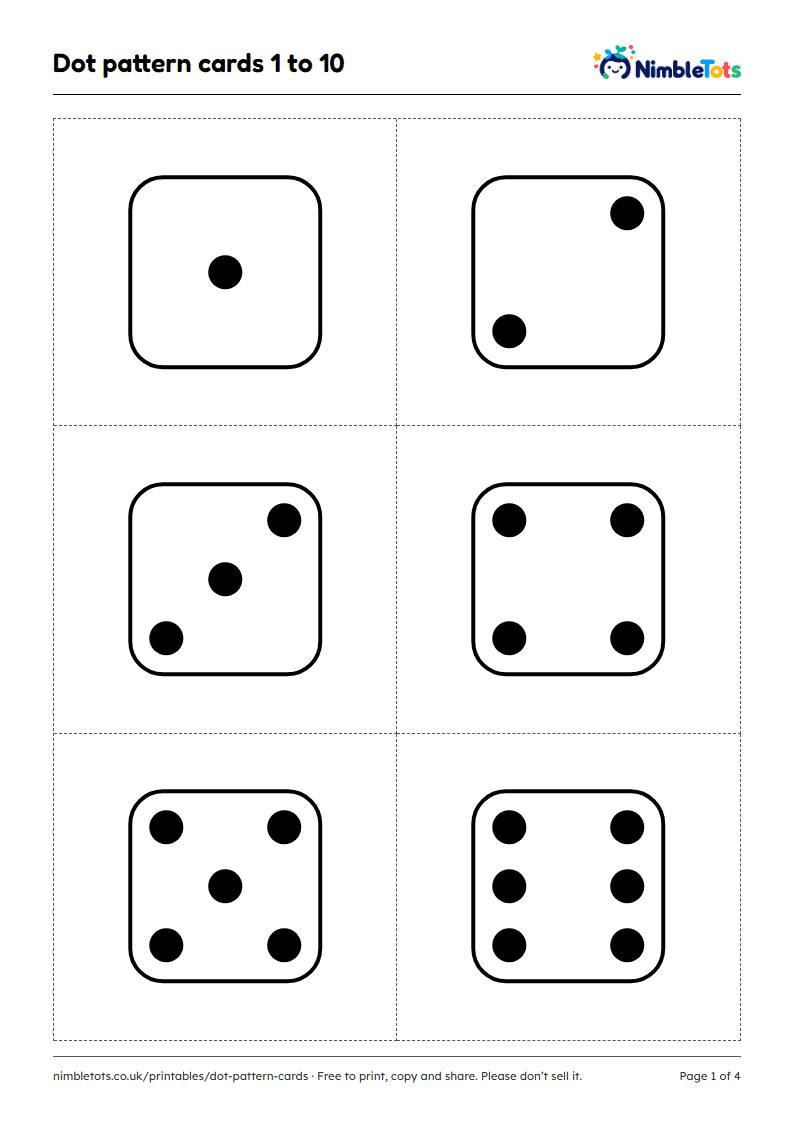
PDF · 4 A4 pages · Reception, Year 1
Flash cards for subitising: dice patterns to 6, scattered dots, and 6 to 10 as "five and a bit" on a ten frame. Show a card for a moment and ask how many.
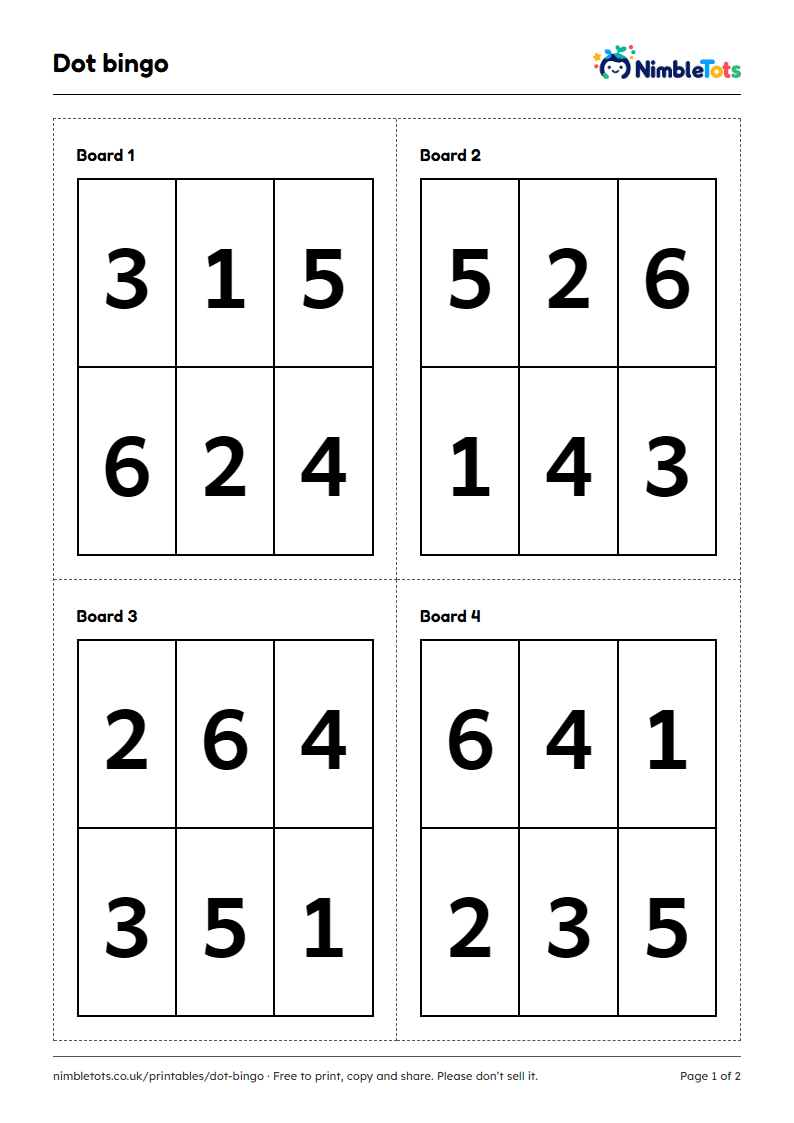
PDF · 2 A4 pages · Reception
A subitising bingo game for a small group. The caller flashes a dot card and players cover the matching number on their board. Four boards and 12 caller cards.
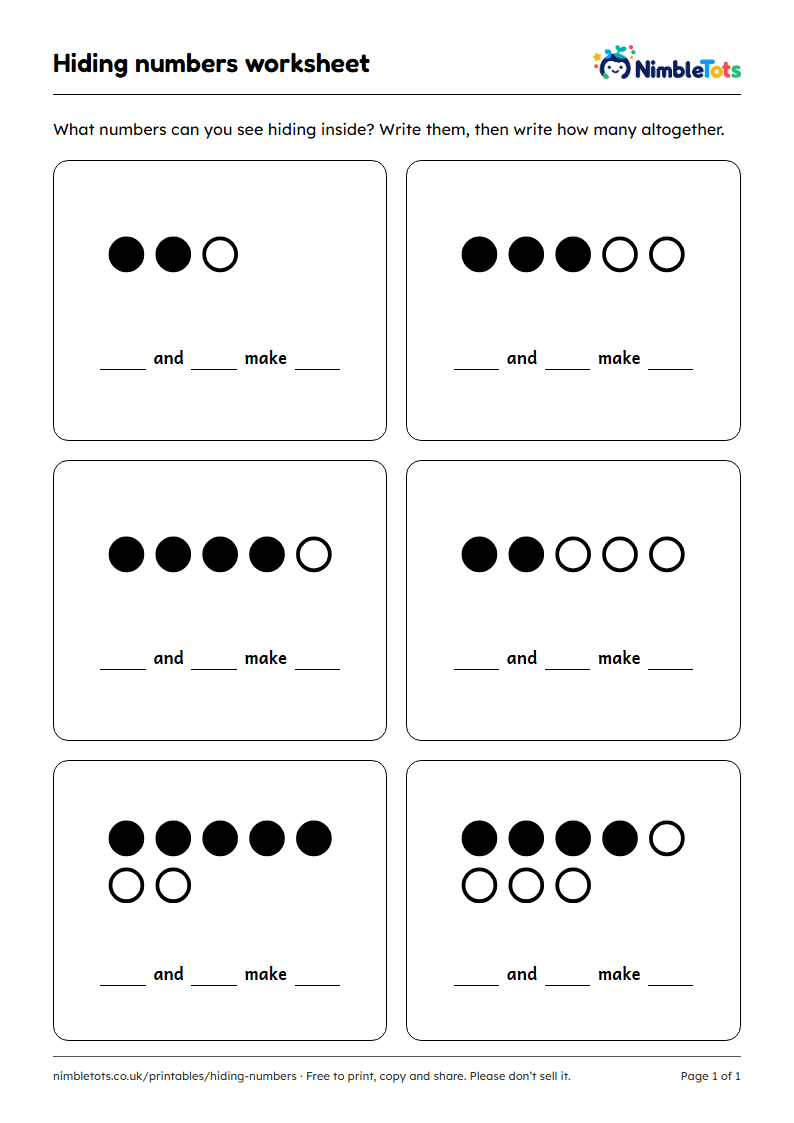
PDF · 1 A4 page · Reception, Year 1
Six groups of dots, each made of two smaller groups. Children spot the numbers hiding inside and write "3 and 2 make 5". Subitising that leads to bonds.
For teachers
The statements in their own words, with the games that practise each one.
| What children learn | Where it comes from | Games |
|---|---|---|
| Subitise (recognise quantities without counting) up to 5. | EYFS Early Learning Goal: Number | Peekaboo dots, Dice flash, See it or count it? |
| Have a deep understanding of numbers to 10, including the composition of each number. | EYFS Early Learning Goal: Number | Hiding numbers, Five and a bit |
| Identify and represent numbers using objects and pictorial representations including the number line, and use the language of: equal to, more than, less than (fewer), most, least. | National Curriculum, Year 1 | Scatter spotter, One push |
It helps children understand what numbers mean, not just say them in order. Seeing 5 as 3 and 2 leads straight to number bonds, adding and taking away.
Perceptual subitising is seeing a small number, up to about 4, straight away. Conceptual subitising is seeing a bigger number as smaller groups, such as 8 as two fours. Children need both.
Most young children can see up to 3 or 4 at a glance. The EYFS expects children to subitise up to 5 by the end of Reception. Bigger numbers are seen as groups.
Free, read aloud and ready in seconds. No sign-up.