
Reception
Tap and count
Count objects to 10, touching each one once.
Talk about it: What did you say last? So how many?
Reception to Year 2 · Free
Free games to count objects, count past 20 and back again, and count in 2s, 5s and 10s. Every question is read aloud.

Quick answer
Counting is more than saying numbers in order. Children need to say one number for each thing, know that the last number they say is how many there are, and see that moving things does not change the total. Good counting games practise each of these, then counting on, counting back and counting in steps.
Games
From counting a handful of toys to counting in tens. Every question is read aloud, and each game ends with something to talk about.
One number for each thing, and the last number says how many. These games practise each part of counting a group.
Count objects to 10, touching each one once.
Talk about it: What did you say last? So how many?
Say how many: the last number I count is the total.
Talk about it: Did you need to count again? Why not?
Count out a number of things from a bigger group.
Talk about it: How did you know when to stop?
Count things however they are arranged, and know moving them doesn't change how many.
Talk about it: Did any frogs hop away? So…?
Saying the numbers in order, past 20 and on to 100, and counting back down again.
Count beyond 20 and hear the pattern.
Talk about it: What happens after nine every time?
Count back from 10, then from 20.
Talk about it: Shall we count down together, quietly?
Count forwards and backwards from any number to 100.
Talk about it: What changes when we count past a ten?
Counting in 2s, 5s and 10s, which leads on to the times tables.
Count in 2s, 5s and 10s, and through the odd numbers.
Talk about it: Why is counting in groups quicker than counting in ones?
Count a big group by putting it into tens.
Talk about it: How many full tens? And how many more?
Count in 2s, 5s and 10s forwards and back, quickly.
Talk about it: How could you check?
Counting small groups again and again is slow. Subitising lets children see 3 or 4 at a glance.
Teaching tips
Counting well takes lots of short goes with real things. These five ideas help at school and at home.
Ask children to touch each thing as they count it, or move it to one side. Nothing gets counted twice or missed.
When the counting stops, ask "So how many are there?" Children who count again have not yet seen that the last number is the total.
Claps, jumps and drum beats are harder because nothing stays still. They build counting in the head.
Rocket countdowns and stepping back down a number track get children ready for taking away.
Pairs of socks for 2s, hands for 5s, ten frames for 10s. Seeing the groups explains why the numbers jump.
Print and play
Free A4 PDFs that print well in black and white. Each one goes with a game, so children can carry on with real objects.
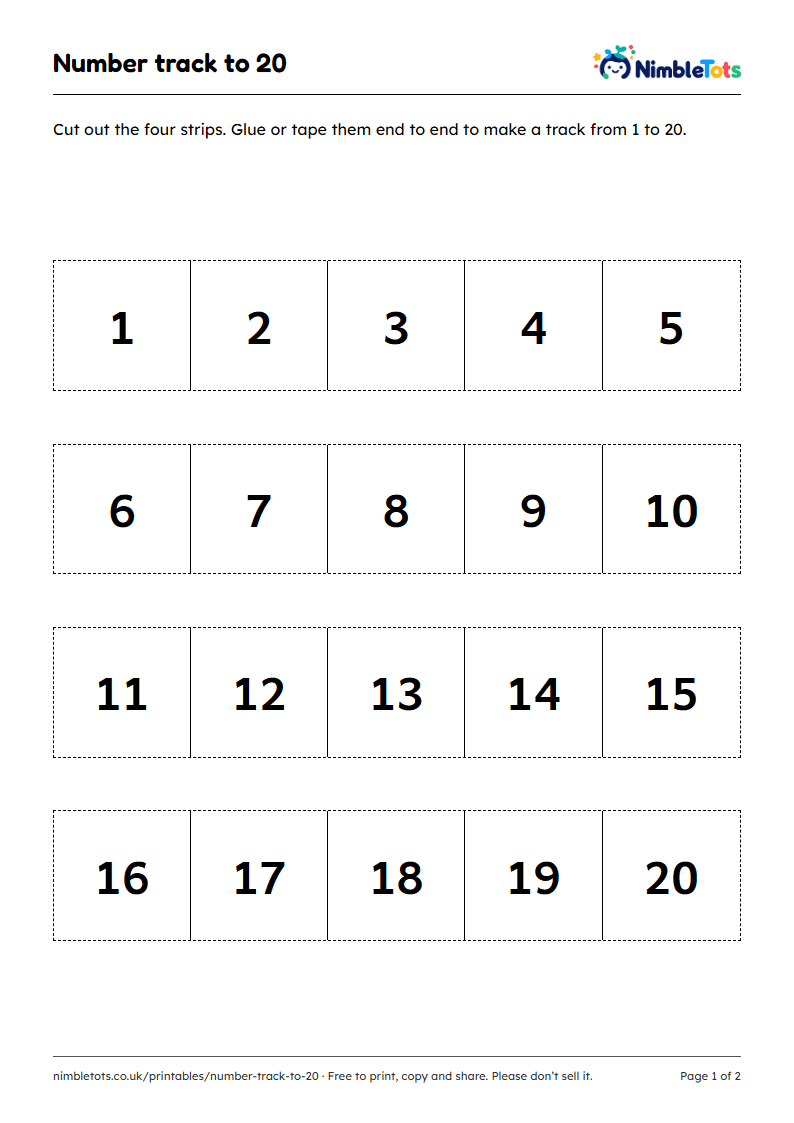
PDF · 2 A4 pages · Reception, Year 1
A number track from 1 to 20 in four strips to cut out and join. Count along it with a toy, forwards and back, and see the pattern after ten.
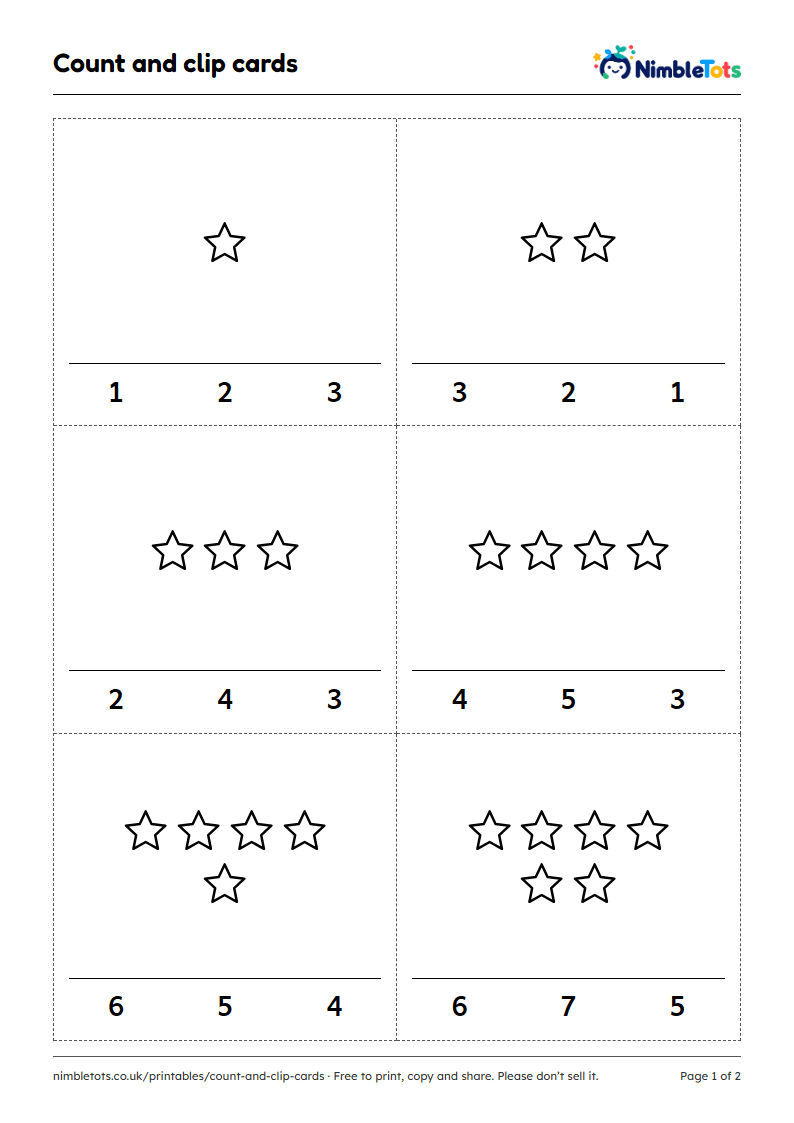
PDF · 2 A4 pages · Reception
Ten cards with 1 to 10 stars. Children count the stars and clip a peg on the right number, learning that the last number they say is the total.
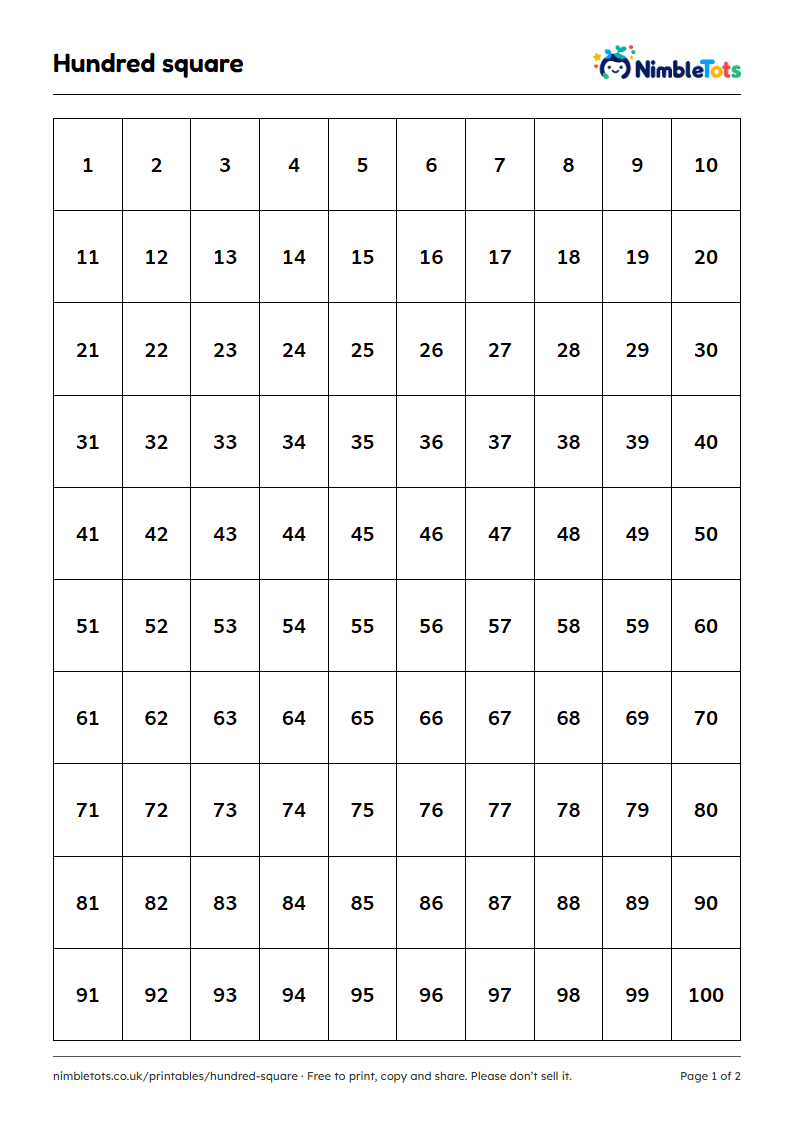
PDF · 2 A4 pages · Year 1, Year 2
A hundred square from 1 to 100, and a second square with gaps to fill in. Use it to count past 100 and in 2s, 5s and 10s, and to spot the patterns.
For teachers
The statements in their own words, with the games that practise each one.
| What children learn | Where it comes from | Games |
|---|---|---|
| Have a deep understanding of numbers to 10, including the composition of each number. | EYFS Early Learning Goal: Number | Tap and count, How many went in?, Still the same? |
| Verbally count beyond 20, recognising the pattern of the counting system. | EYFS Early Learning Goal: Numerical patterns | Past twenty, Rocket countdown |
| Count to and across 100, forwards and backwards, beginning with 0 or 1, or from any given number. | National Curriculum, Year 1 | Number snake, Tidy into tens |
| Count, read and write numbers to 100 in numerals; count in multiples of 2s, 5s and 10s. | National Curriculum, Year 1 | Socks and gloves |
Most children start saying numbers at two or three, and count objects reliably at four or five. In Reception they count beyond 20 and understand numbers to 10 well. In Year 1 they count to 100 and in 2s, 5s and 10s.
Matching one number to one thing is a skill of its own. Ask them to touch or move each thing as they count it. It usually settles with practice.
Yes. Every game is free, with no sign-up and no adverts. They work on tablets, computers and interactive whiteboards.
Free, read aloud and ready in seconds. No sign-up.