
Number bonds to 10
Ten frame bond cards
PDF · 3 A4 pages · Reception, Year 1
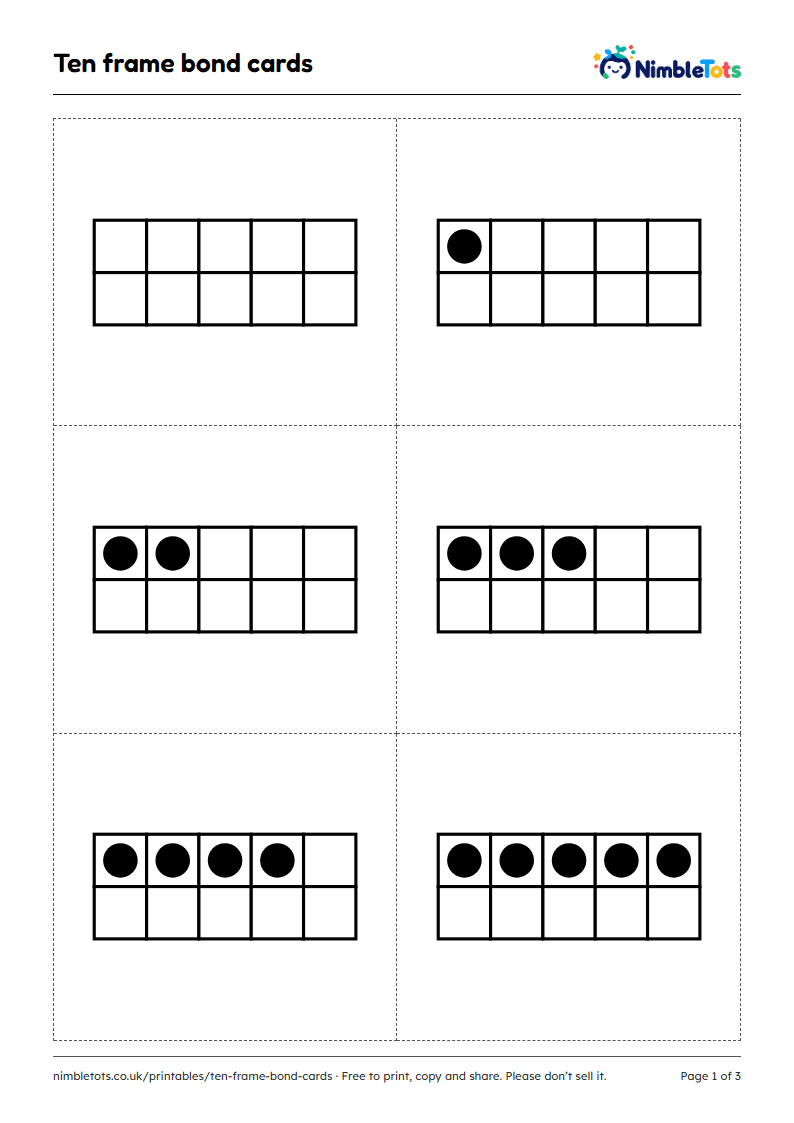
Cards showing 0 to 10 on a ten frame, for matching each number with its partner to make ten. Use them for find my partner, snap or a quick flash.
Reception · Free
What the six maths goals ask for by the end of Reception, what each looks like in class, and free games and printables to practise them.

Quick answer
EYFS maths is the mathematics children learn in the Early Years Foundation Stage, which ends with Reception. It has two Early Learning Goals. Number is about numbers to 10 and how they are made. Numerical patterns is about counting, comparing and spotting patterns. Children learn it through play, talk and real objects.
The goals
Each Early Learning Goal for mathematics, in the framework’s own words, with the Reception games that practise it.
| Early Learning Goal | Activities |
|---|---|
| Have a deep understanding of numbers to 10, including the composition of each number. | Tap and count, How many went in?, Feed the hedgehog, Still the same?, Count the drum, Number match, Find the plate, Empty nest, Fill the frame, Show me fingers, Hiding numbers, Five and a bit, Two plates, Shake the beans, Fill the gaps, Staircase, Picnic baskets, First, then, now |
| Subitise (recognise quantities without counting) up to 5. | Peekaboo dots, Dice flash, See it or count it?, Hiding numbers |
| Automatically recall (without reference to rhymes, counting or other aids) number bonds up to 5 (including subtraction facts) and some number bonds to 10, including double facts. | Mice in the house, Beads behind the hand, Ladybird doubles |
| Verbally count beyond 20, recognising the pattern of the counting system. | What comes next?, Past twenty, Rocket countdown, Track hop, Track race |
| Compare quantities up to 10 in different contexts, recognising when one quantity is greater than, less than or the same as the other quantity. | Party plates, Elephants and mice, Staircase, Washing line |
| Explore and represent patterns within numbers up to 10, including evens and odds, double facts and how quantities can be distributed equally. | Ladybird doubles, Teddy picnic, Is it fair?, Partners, Double and half |
Tap and count, How many went in?, Feed the hedgehog, Still the same?, Count the drum, Number match, Find the plate, Empty nest, Fill the frame, Show me fingers, Hiding numbers, Five and a bit, Two plates, Shake the beans, Fill the gaps, Staircase, Picnic baskets, First, then, now
Peekaboo dots, Dice flash, See it or count it?, Hiding numbers
Mice in the house, Beads behind the hand, Ladybird doubles
What comes next?, Past twenty, Rocket countdown, Track hop, Track race
Party plates, Elephants and mice, Staircase, Washing line
Ladybird doubles, Teddy picnic, Is it fair?, Partners, Double and half
From the EYFS statutory framework for group and school-based providers (September 2026), early learning goals.
Teaching tips
Reception maths happens all day, not just at maths time. These five ideas fit into the day as it is.
Snack time, lining up, steps on the stairs. Counting real things, and saying the last number as the total, matters more than counting high.
Show 5 as fingers, dots on a dice, a ten frame and two groups of toys. Ask what is the same and what is different.
Show small groups for a moment and ask how many. Subitising up to 5 is one of the goals, and it grows from quick looks, not counting.
Compare two plates of snacks or two towers of bricks. Ask how they know, and whether they could make them the same.
Share things between two teddies. Which numbers share fairly and which leave one over? That is odd and even, long before the words.
Print and play
Every printable that suits Reception, including a class record sheet for the six maths goals. Free A4 PDFs that print well in black and white.
PDF · 3 A4 pages · Reception, Year 1
Cards showing 0 to 10 on a ten frame, for matching each number with its partner to make ten. Use them for find my partner, snap or a quick flash.
PDF · 3 A4 pages · Reception, Year 1
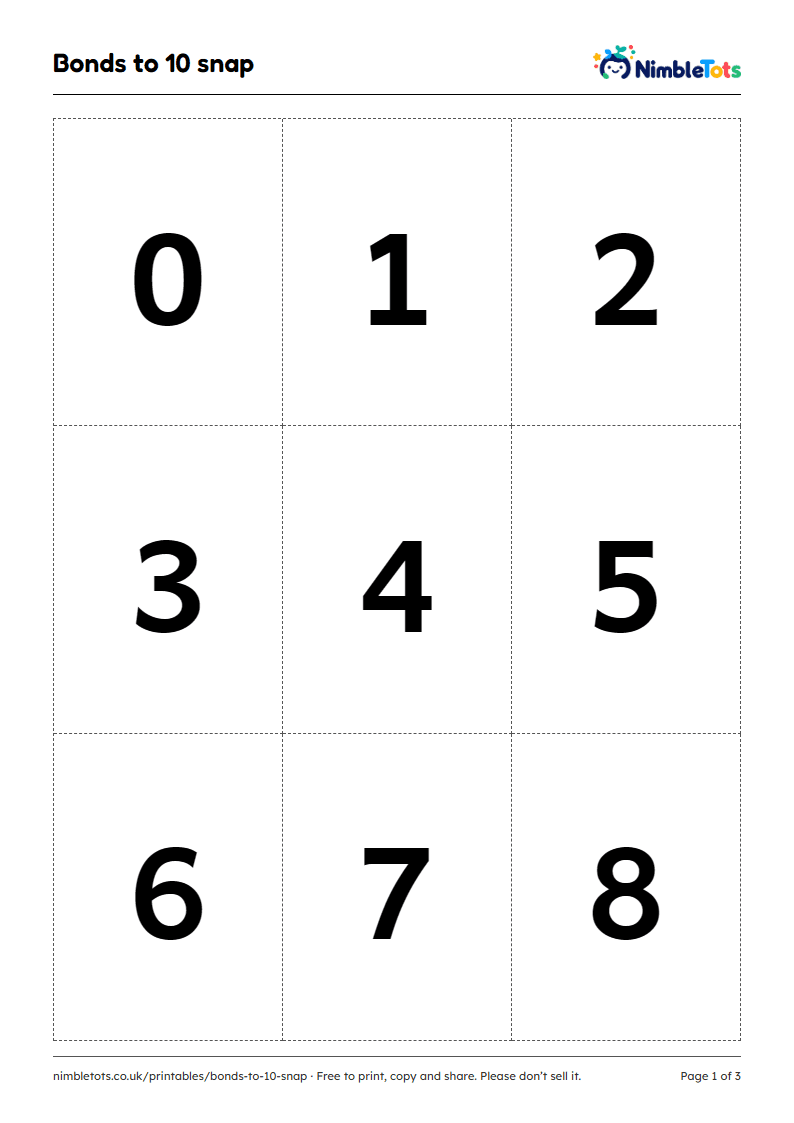
A card game for two or three players. Turn over numeral cards and shout "Snap!" when two cards make ten. Quick practice for recall of bonds to 10.
PDF · 2 A4 pages · Reception, Year 1
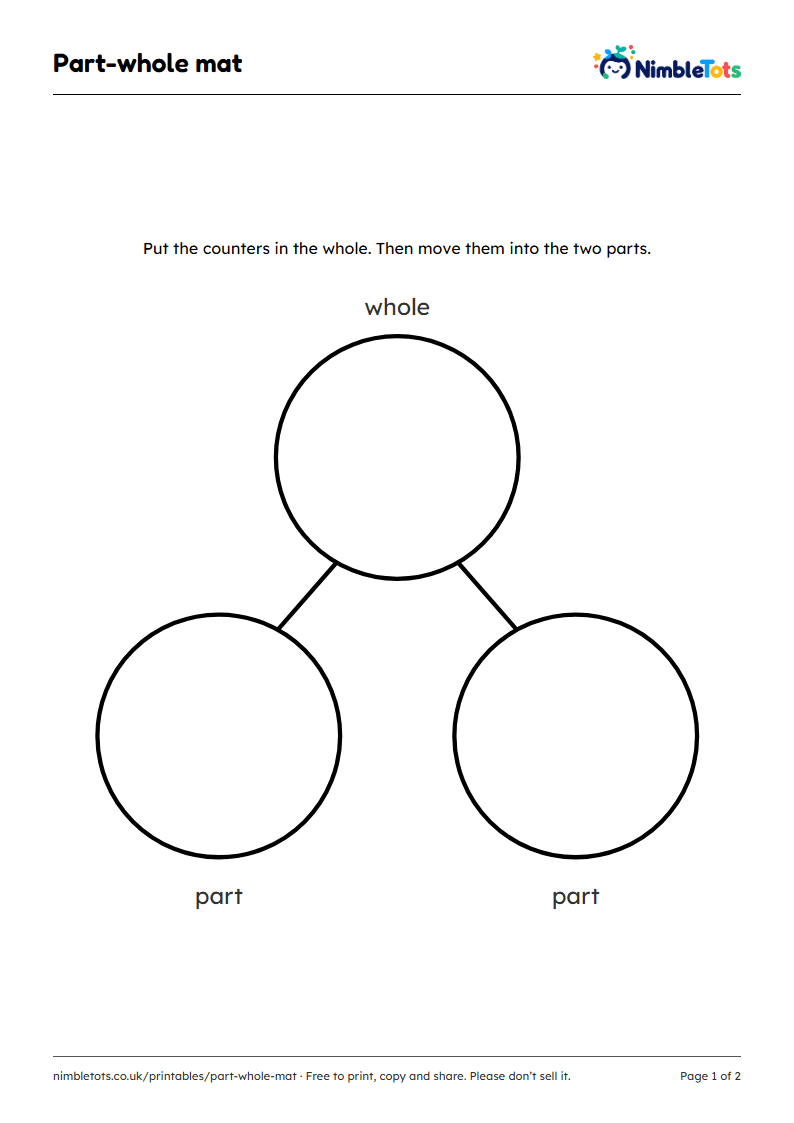
A large mat with a whole and two parts. Put counters in the whole, then split them between the parts to see the bonds inside any number to 10.
PDF · 4 A4 pages · Reception, Year 1
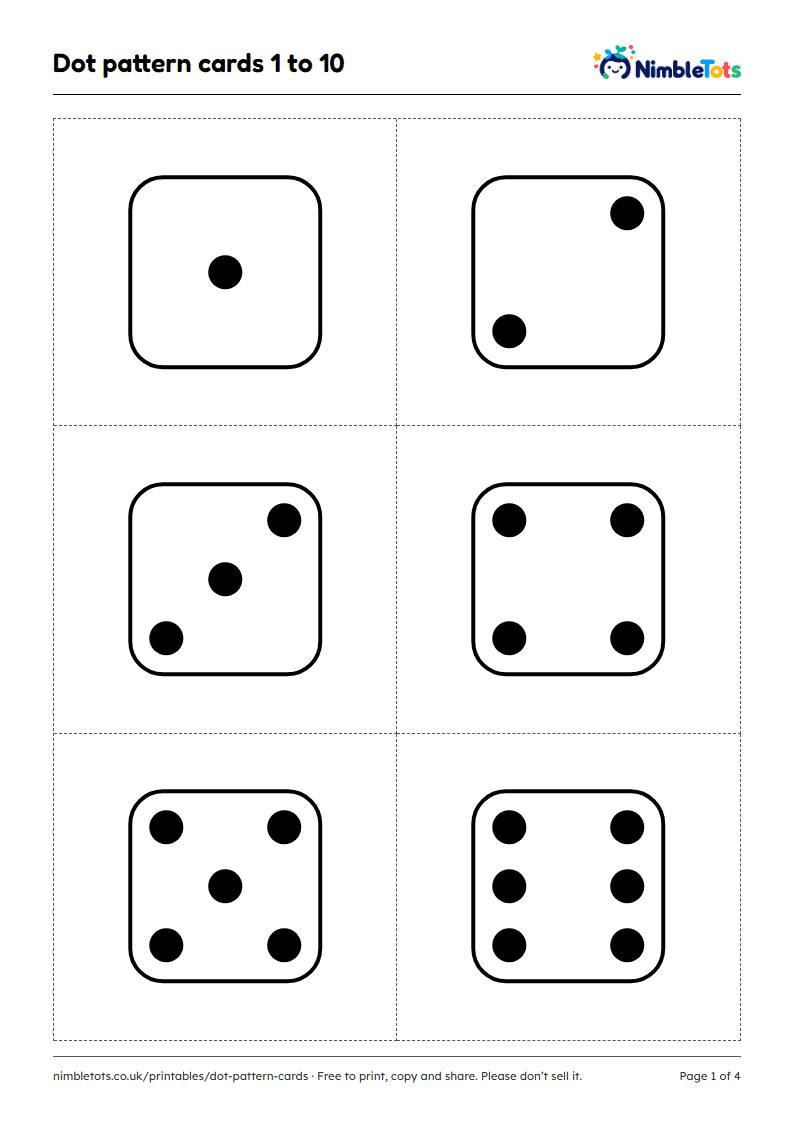
Flash cards for subitising: dice patterns to 6, scattered dots, and 6 to 10 as "five and a bit" on a ten frame. Show a card for a moment and ask how many.
PDF · 2 A4 pages · Reception
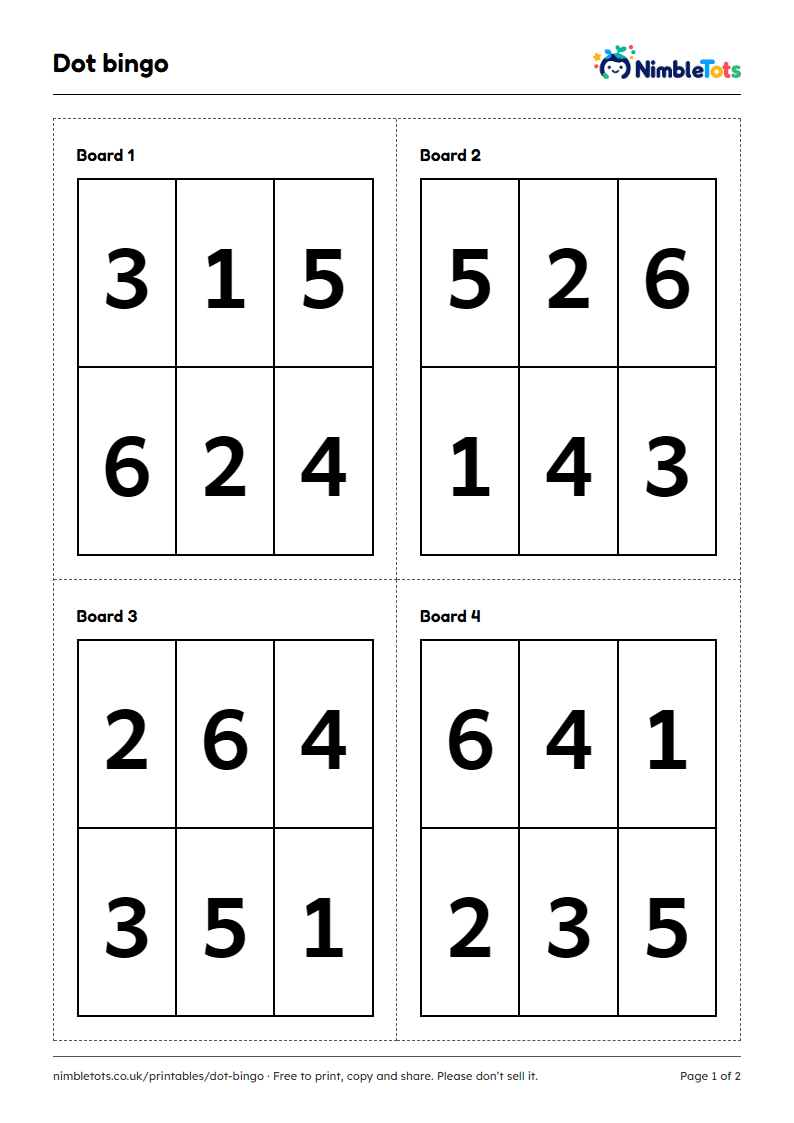
A subitising bingo game for a small group. The caller flashes a dot card and players cover the matching number on their board. Four boards and 12 caller cards.
PDF · 1 A4 page · Reception, Year 1
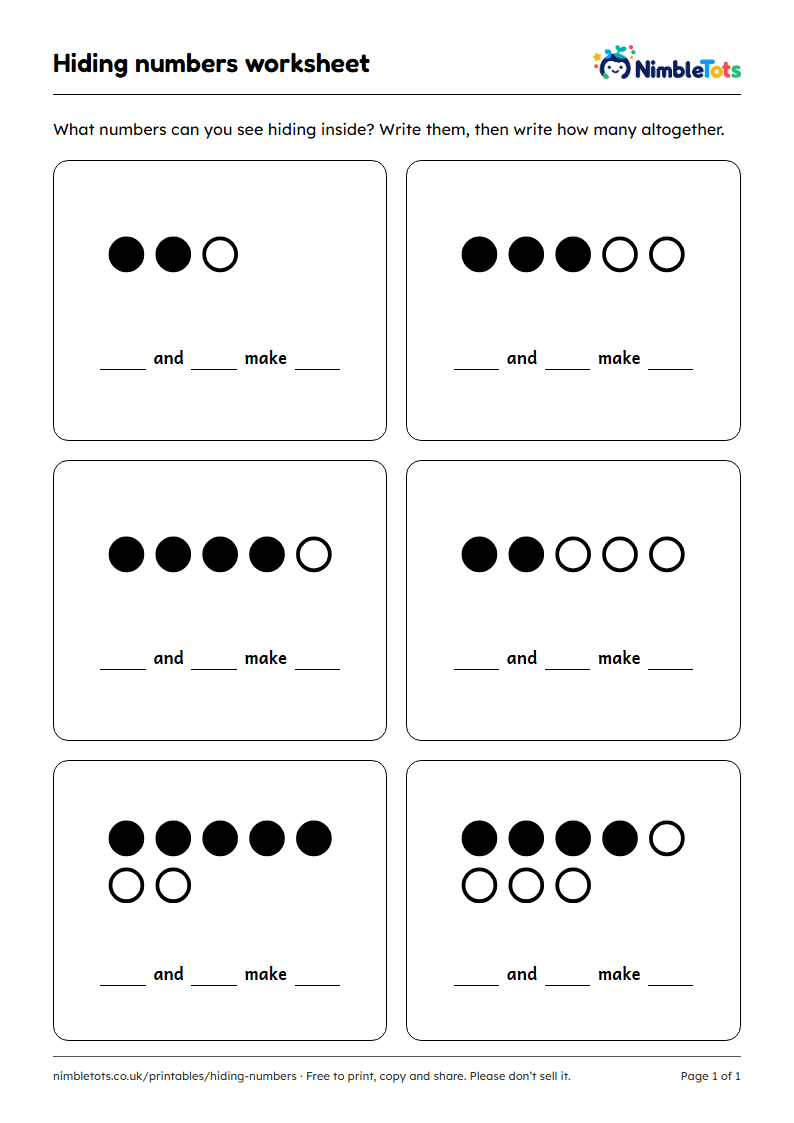
Six groups of dots, each made of two smaller groups. Children spot the numbers hiding inside and write "3 and 2 make 5". Subitising that leads to bonds.
PDF · 2 A4 pages · Reception, Year 1
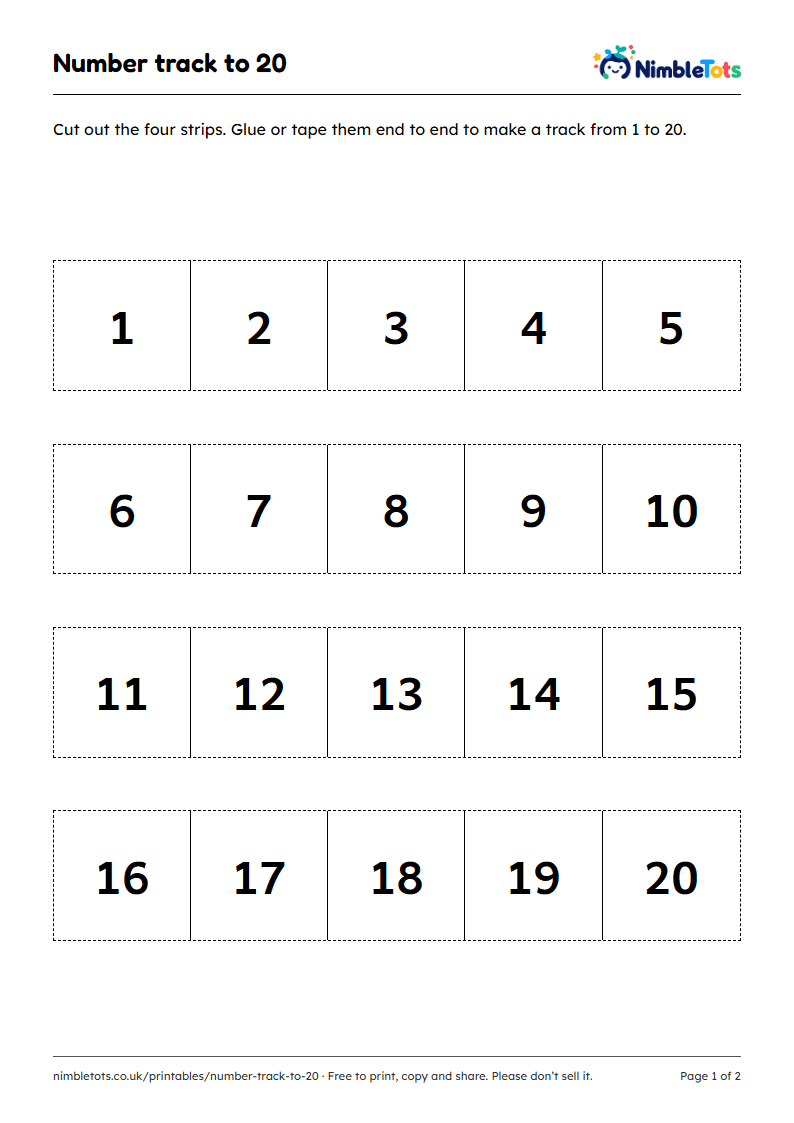
A number track from 1 to 20 in four strips to cut out and join. Count along it with a toy, forwards and back, and see the pattern after ten.
PDF · 2 A4 pages · Reception
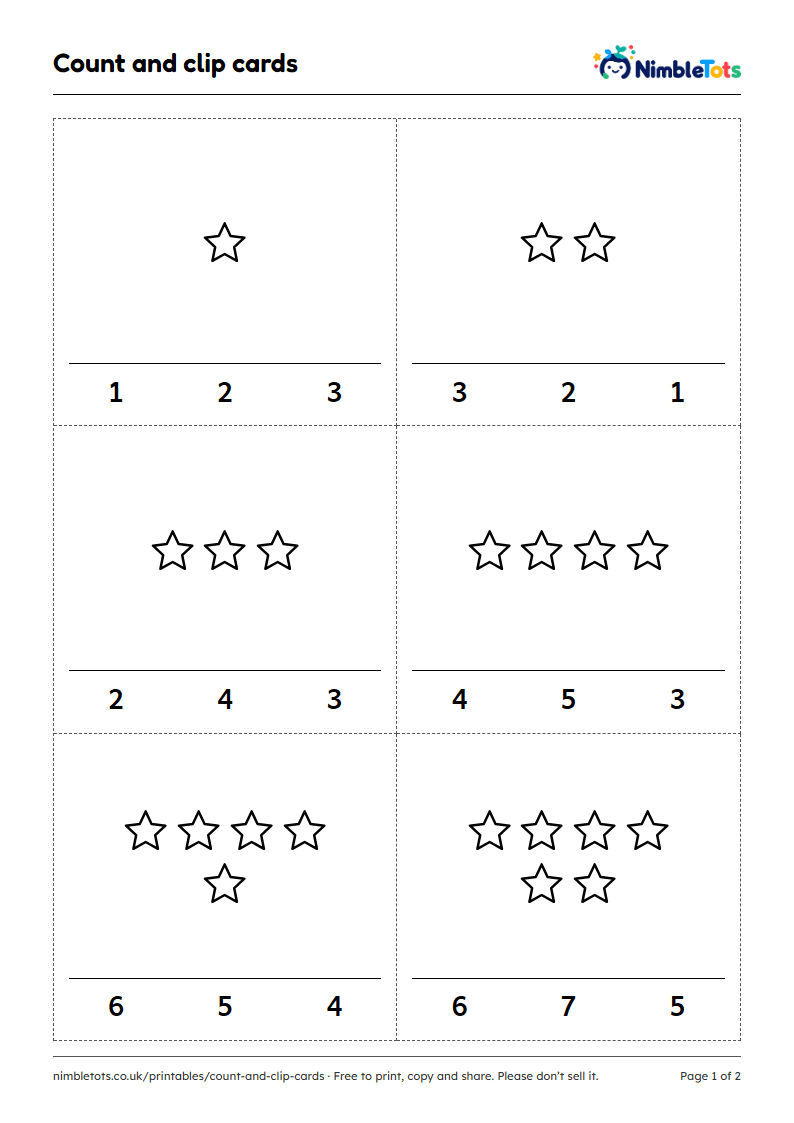
Ten cards with 1 to 10 stars. Children count the stars and clip a peg on the right number, learning that the last number they say is the total.
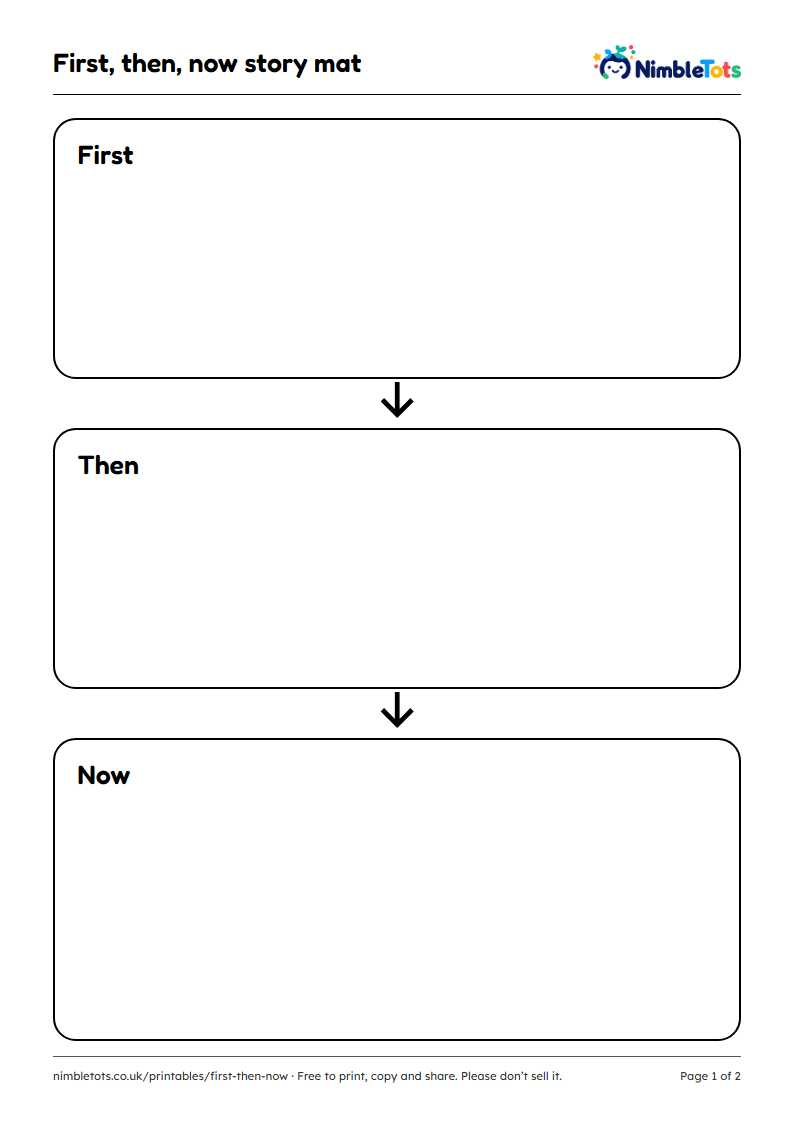
PDF · 2 A4 pages · Reception, Year 1
A story mat with three boxes, First, Then and Now, and six short stories to read aloud. Act each story out with toys to see adding and taking away.
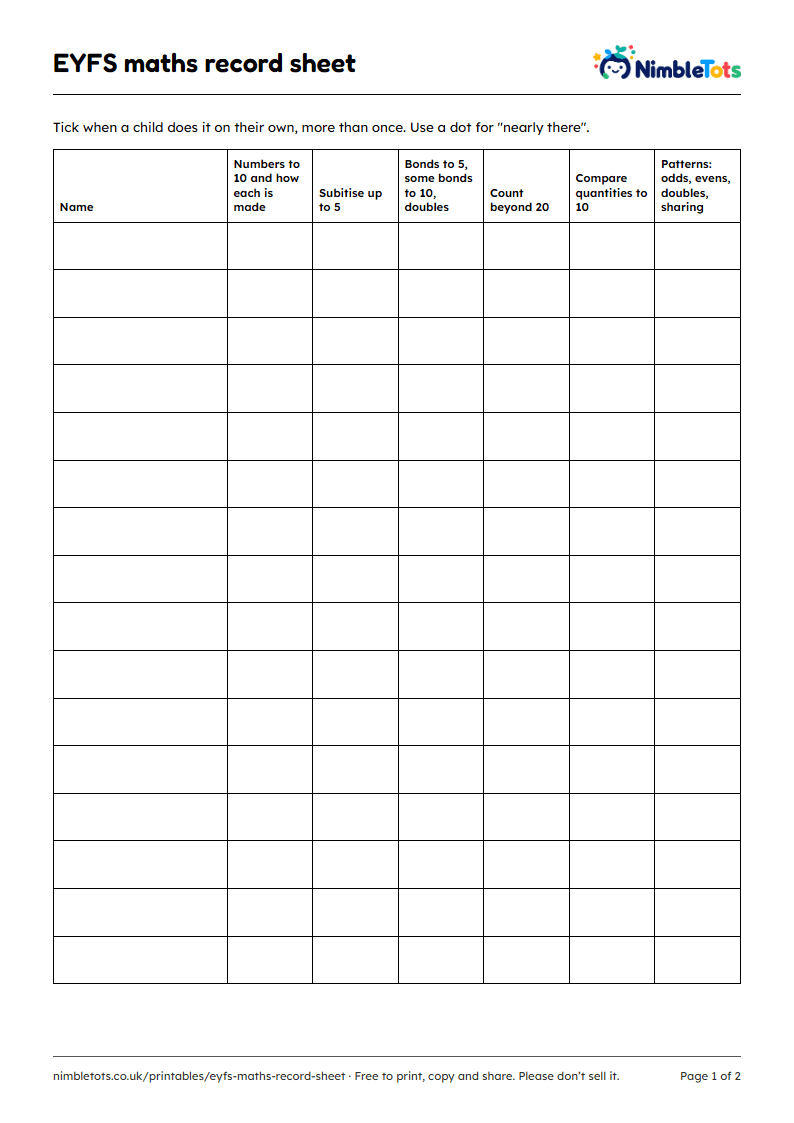
PDF · 2 A4 pages · Reception
A class record sheet for the six Early Learning Goals in mathematics, with each goal in full and what it looks like in class. For Reception teachers.
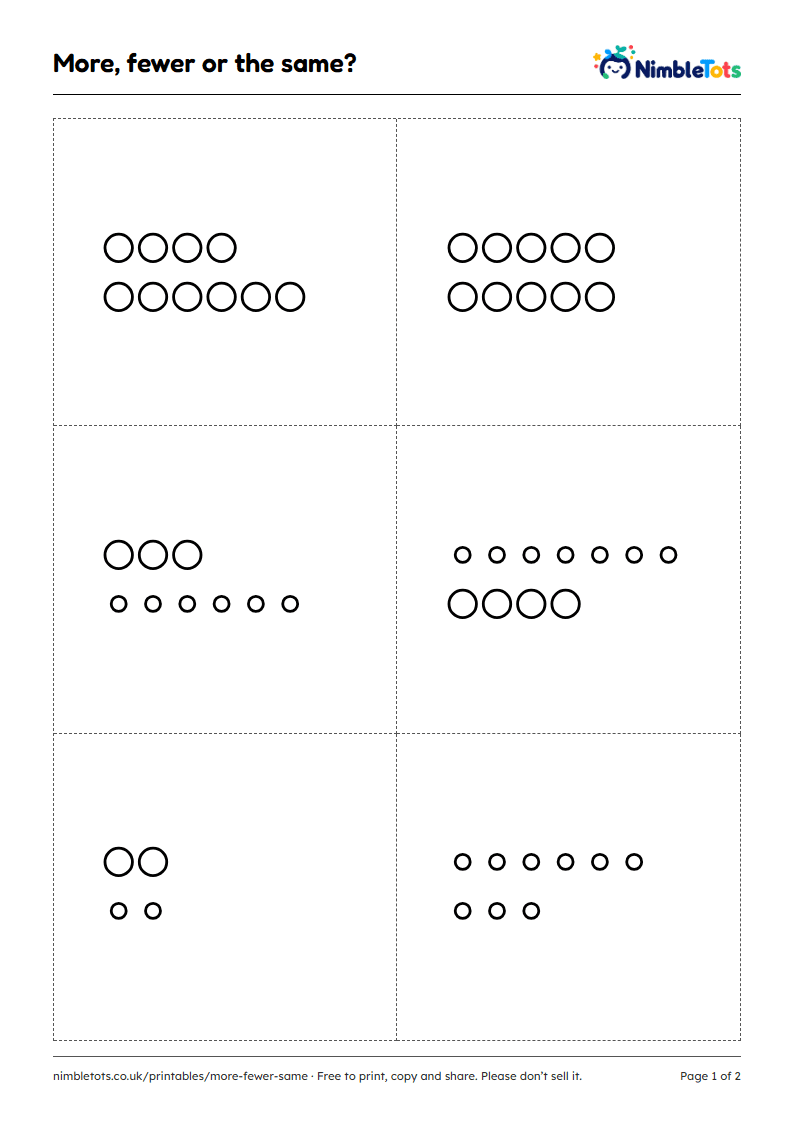
PDF · 2 A4 pages · Reception
Six cards with two rows of spots to compare, some big and some small, so size can’t give the answer away. Say which row has more, fewer or the same.
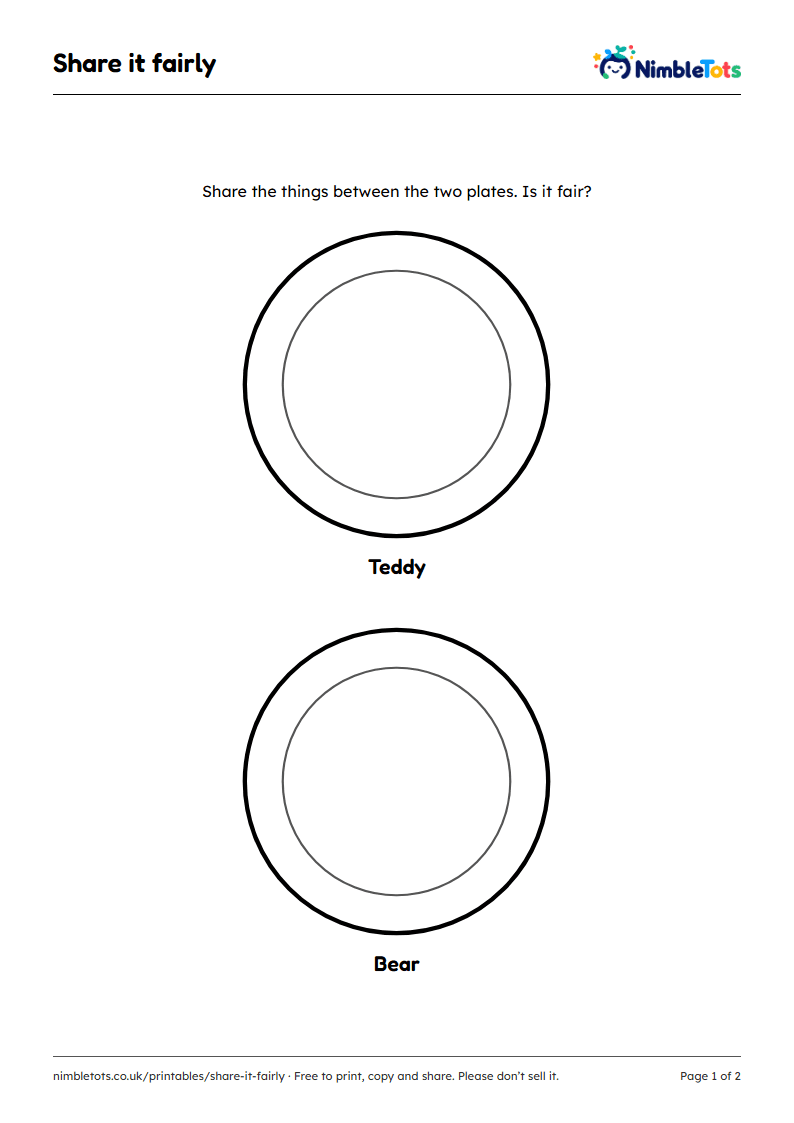
PDF · 2 A4 pages · Reception
Two plates to share things between, and number cards to sort into "shares fairly" and "one left over". Odd and even numbers, long before the words.
PDF · 1 A4 page · Reception
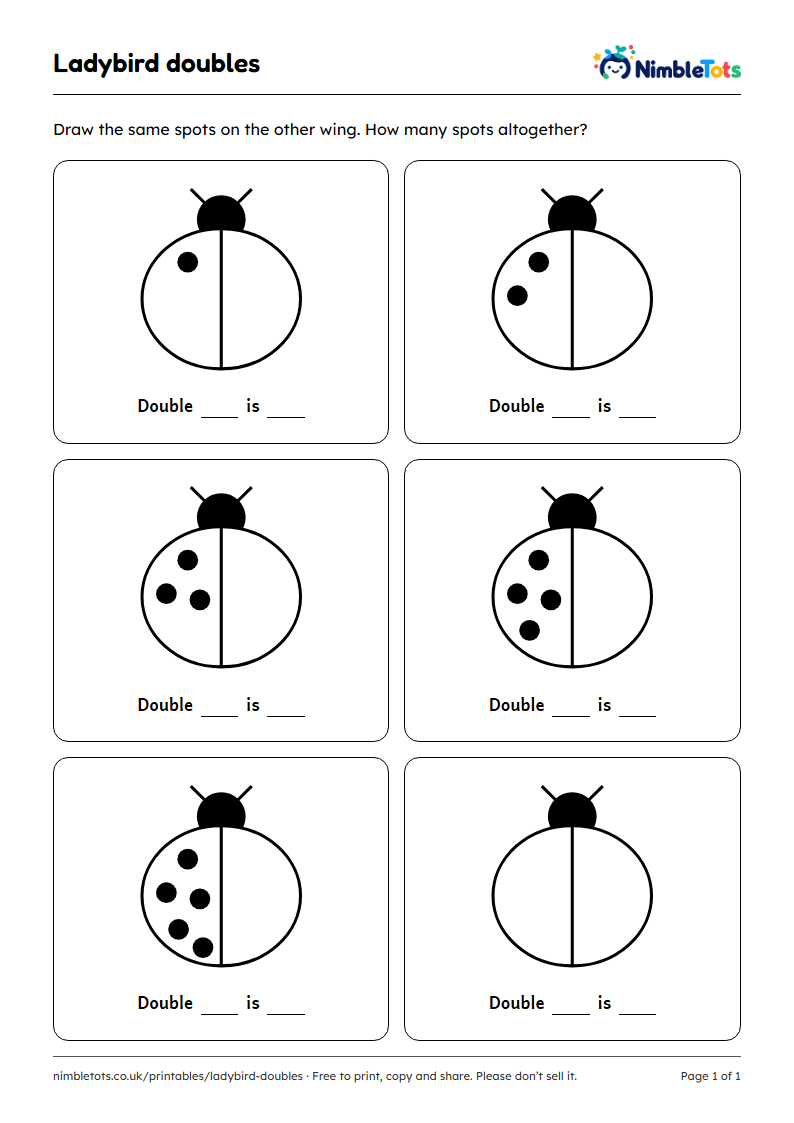
Six ladybirds with spots on one wing. Children draw the same on the other wing, say the double from double 1 to double 5, and write how many.
PDF · 2 A4 pages · Reception
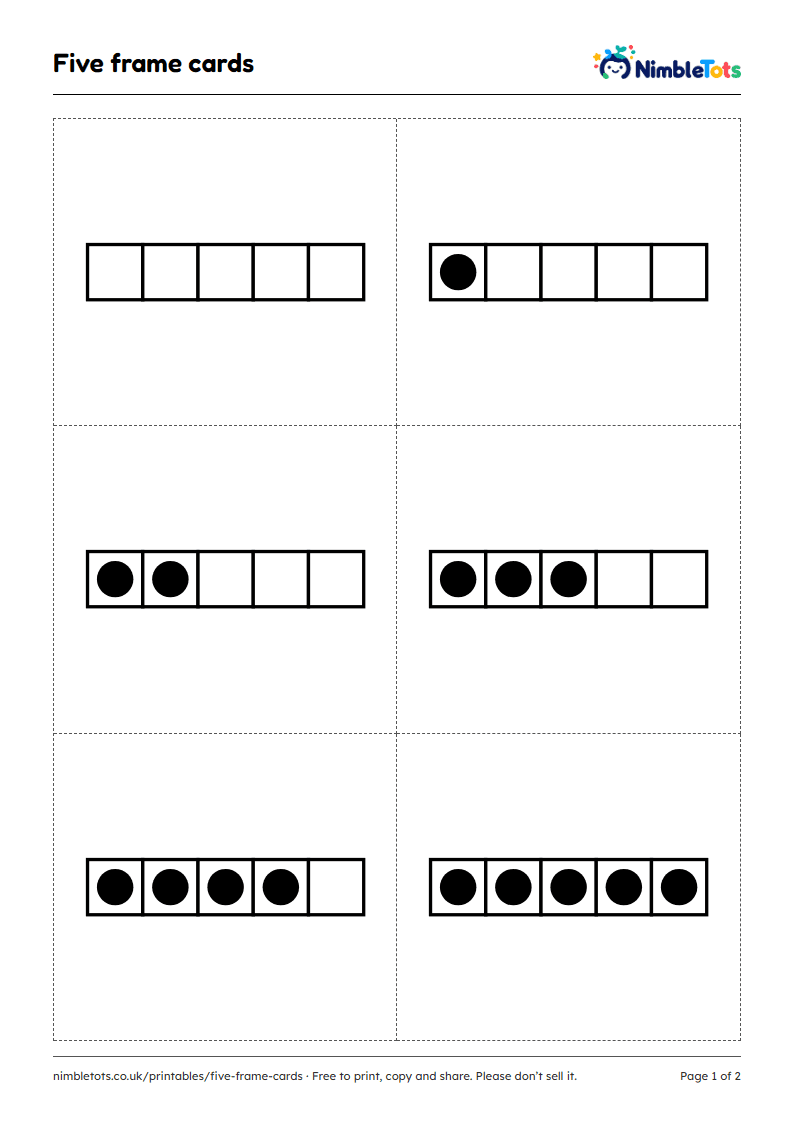
Cards showing 0 to 5 on a five frame, for bonds to 5. Children say how many counters and how many spaces, then find the card that makes five with it.
PDF · 2 A4 pages · Reception
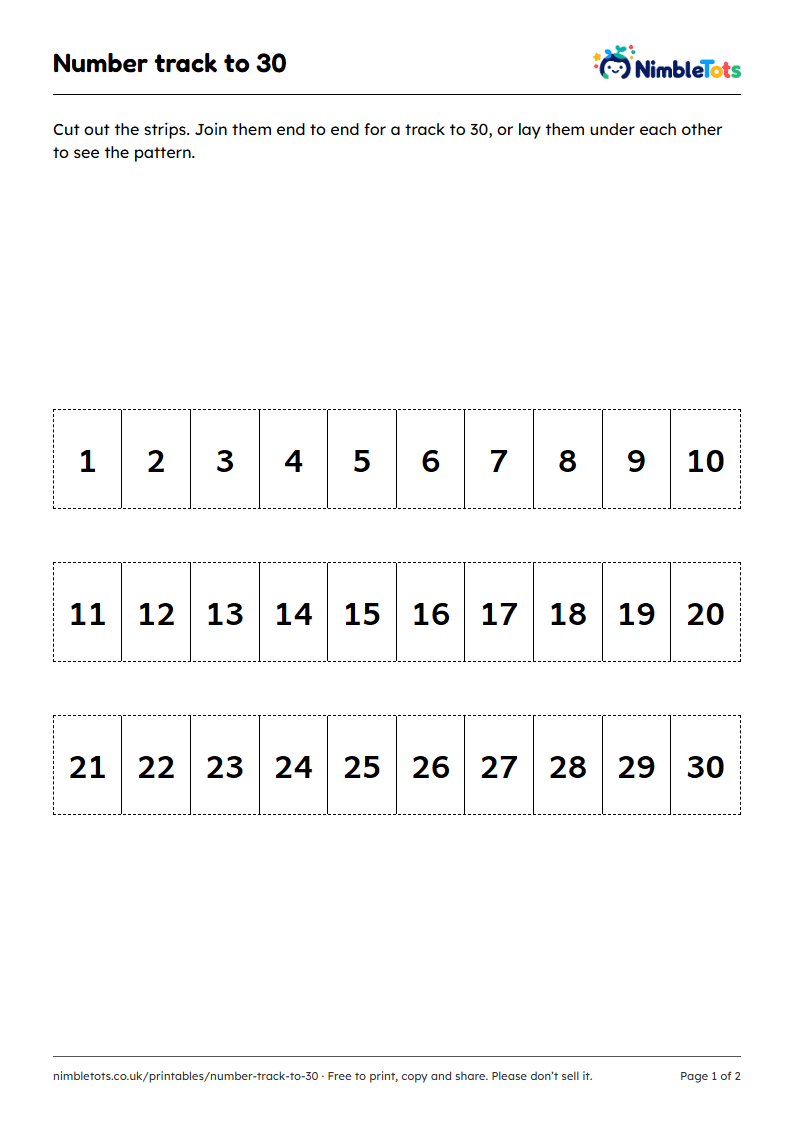
A number track from 1 to 30 in three strips of ten. Count along it past 20 and hear the pattern repeat: twenty-one, twenty-two, like one, two.
There are two: Number and Numerical patterns. Number covers numbers to 10 and how they are made, subitising up to 5 and recalling number bonds. Numerical patterns covers counting beyond 20, comparing quantities and patterns such as odds, evens and doubles.
At the end of Reception, teachers judge whether each child meets the expected level for each goal, using what they know of the child day to day. There is no test. The record sheet on this page can help you keep track.
Reception is the last year of the EYFS, so Reception maths follows the EYFS framework and its Early Learning Goals. Year 1 then follows the National Curriculum.
Little and often works best. A few minutes of play with a grown-up nearby, and plenty of talk, does more than a long session.
Free, read aloud and ready in seconds. No sign-up.