
Reception
Two plates
See that numbers to 5 are made of smaller parts.
Talk about it: Can you show it on your fingers?
Reception and Year 1 · Free
Free games, teaching tips and printables to help children see how numbers to 10 are made, then know the pairs that make ten without counting.

Quick answer
Number bonds to 10 are the pairs of numbers that add up to 10: 0 and 10, 1 and 9, 2 and 8, 3 and 7, 4 and 6, and 5 and 5. Children first see them on a ten frame or with objects, then learn to recall them without counting. Knowing them by heart makes adding and taking away much easier.
Games
Two steps: first seeing how ten is made, then knowing the pairs by heart. Every question is read aloud, and each game ends with something to talk about.
Start with objects and pictures, so children can see how ten is made before they try to remember it.
See that numbers to 5 are made of smaller parts.
Talk about it: Can you show it on your fingers?
See how numbers to 10 are made, on a ten frame.
Talk about it: Can you see it without counting?
Know some bonds to 10.
Talk about it: Which bond to ten did you use?
Once children can see the bonds, short and frequent practice helps them recall each pair straight away.
Know all the bonds to 10 quickly.
Talk about it: Can you picture the ten frame?
Use a bond to find its take-away facts (fact families) within 10.
Talk about it: Which number is the whole?
Once bonds to 10 are quick, adding gets easier: 8 + 5 is 8 + 2, then 3 more, so 13.
Teaching tips
Short, frequent practice with real objects works best. These five ideas suit the classroom and home alike.
Bonds to 5 come first. Once children know that 3 and 2 make 5, they can see 8 as five and three, and 10 as five and five.
Counters fill the top row first. Children can see how many are there and how many spaces are left, and the spaces are the partner to ten.
Cover part of the ten and ask how many are hiding. A fact becomes a puzzle, and children practise the missing part thinking they need for taking away.
7 and 3 make 10, and 3 and 7 make 10. Then the take-away facts: 10 take away 3 is 7. One bond gives four facts.
Two minutes at the start of a lesson, or on the way to school, does more than one long session. Ask a bond, wait, then ask how they knew.
Print and play
Free A4 PDFs that print well in black and white. Each one goes with a game, so children can carry on with real objects.
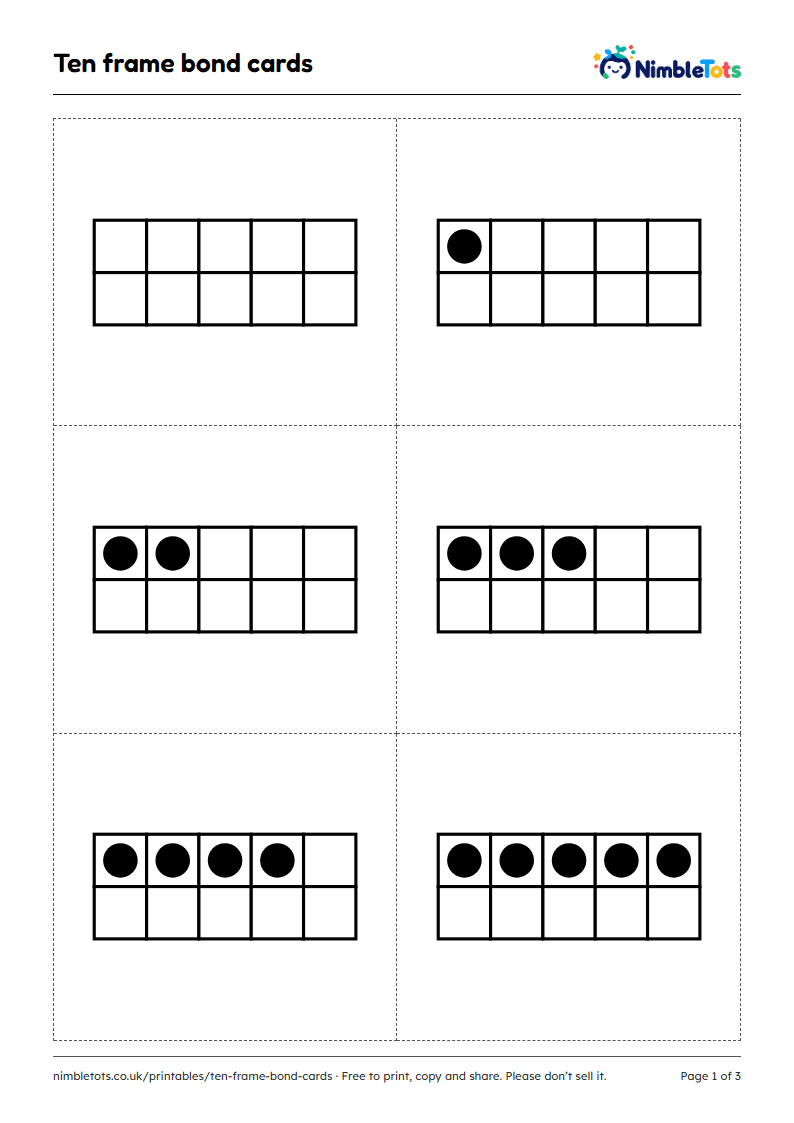
PDF · 3 A4 pages · Reception, Year 1
Cards showing 0 to 10 on a ten frame, for matching each number with its partner to make ten. Use them for find my partner, snap or a quick flash.
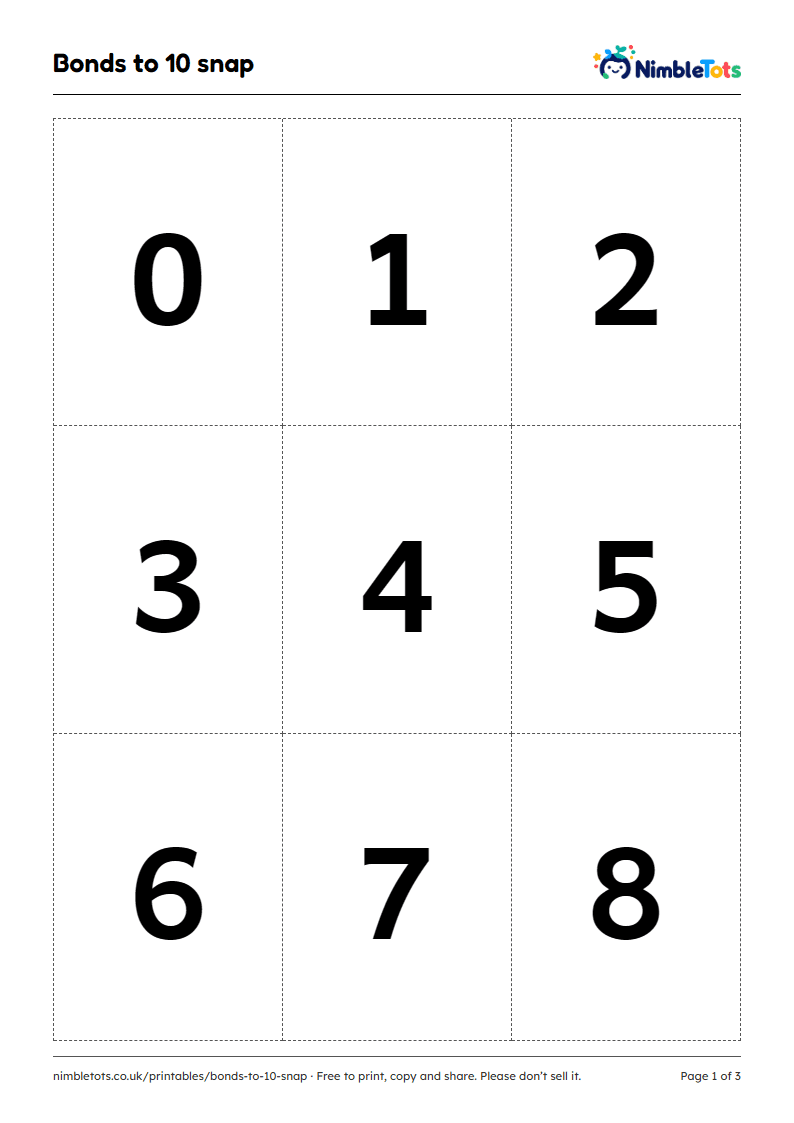
PDF · 3 A4 pages · Reception, Year 1
A card game for two or three players. Turn over numeral cards and shout "Snap!" when two cards make ten. Quick practice for recall of bonds to 10.
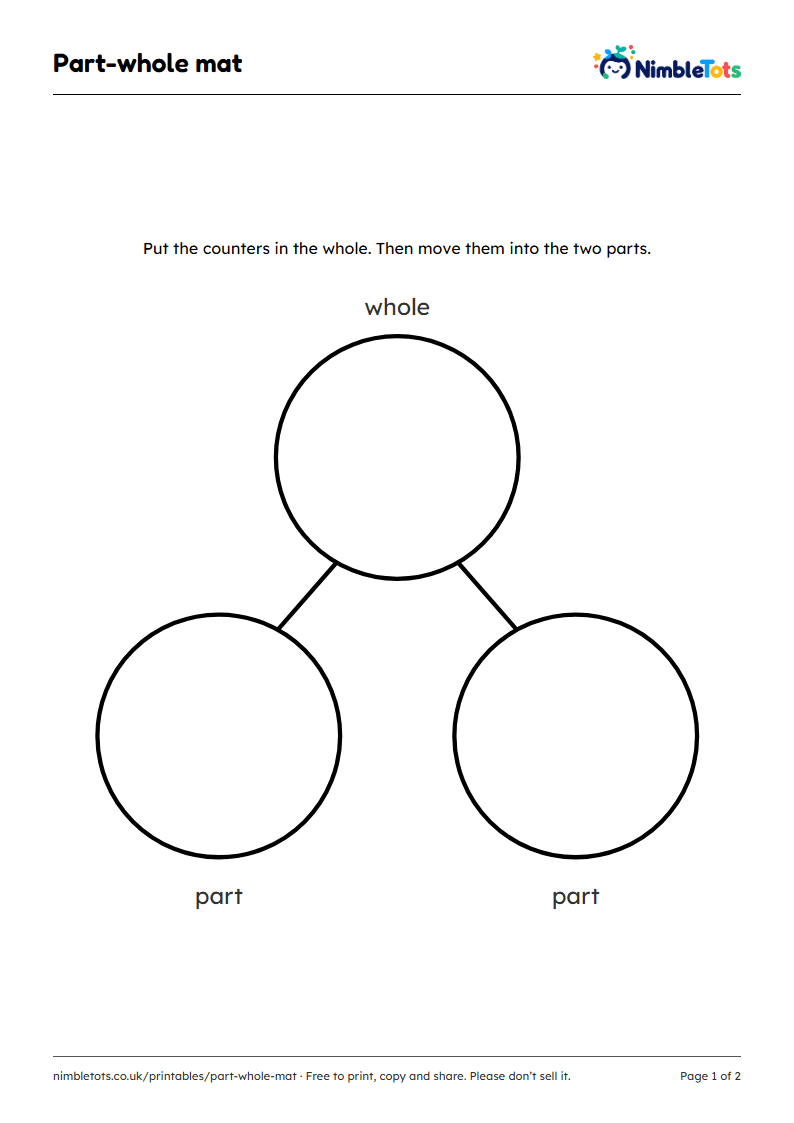
PDF · 2 A4 pages · Reception, Year 1
A large mat with a whole and two parts. Put counters in the whole, then split them between the parts to see the bonds inside any number to 10.
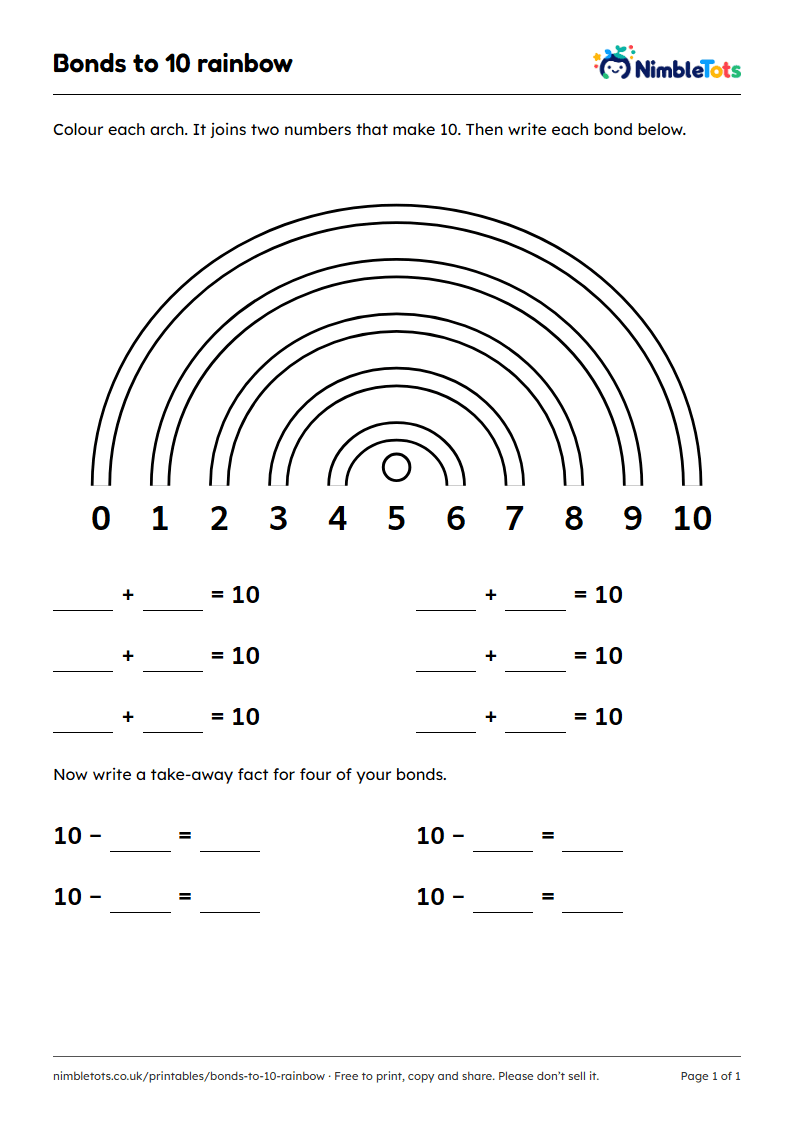
PDF · 1 A4 page · Year 1
Colour each arch of the rainbow to join a number to its partner to ten, then write the bonds as number sentences. A one-page worksheet for Year 1.
For teachers
The statements in their own words, with the games that practise each one.
| What children learn | Where it comes from | Games |
|---|---|---|
| Have a deep understanding of numbers to 10, including the composition of each number. | EYFS Early Learning Goal: Number | Two plates, Fill the gaps |
| Automatically recall (without reference to rhymes, counting or other aids) number bonds up to 5 (including subtraction facts) and some number bonds to 10, including double facts. | EYFS Early Learning Goal: Number | Beads behind the hand |
| Represent and use number bonds and related subtraction facts within 20. | National Curriculum, Year 1 | Partners to ten, Fact family house |
| Develop fluency in addition and subtraction facts within 10. | Ready-to-progress 1NF-1, Year 1 | Partners to ten |
In Reception, children learn how numbers to 10 are made and know some bonds to 10. By the end of Year 1 they should recall all the bonds to 10 quickly, as the National Curriculum and the ready-to-progress criteria expect.
A number bond is the two parts that make a whole. Each bond gives two addition facts and two subtraction facts: 7 and 3 make 10, so 7 + 3 = 10, 3 + 7 = 10, 10 − 7 = 3 and 10 − 3 = 7.
Use fingers: hold up 6 and ask how many more make 10. Play snap with the bond cards, or hide some toys under a cup and ask how many are hiding. A few minutes a day is plenty.
Bonds to 10 lead straight on to adding across ten, such as 8 + 5 = 13: make ten first, then add the rest. The addition games practise this next.
Free, read aloud and ready in seconds. No sign-up.